RO system guide
Tankless RO vs Traditional RO Systems: Which Is Right for Your Market?
Compare tankless and traditional RO platforms across installation, water delivery, maintenance, smart features and OEM market positioning.
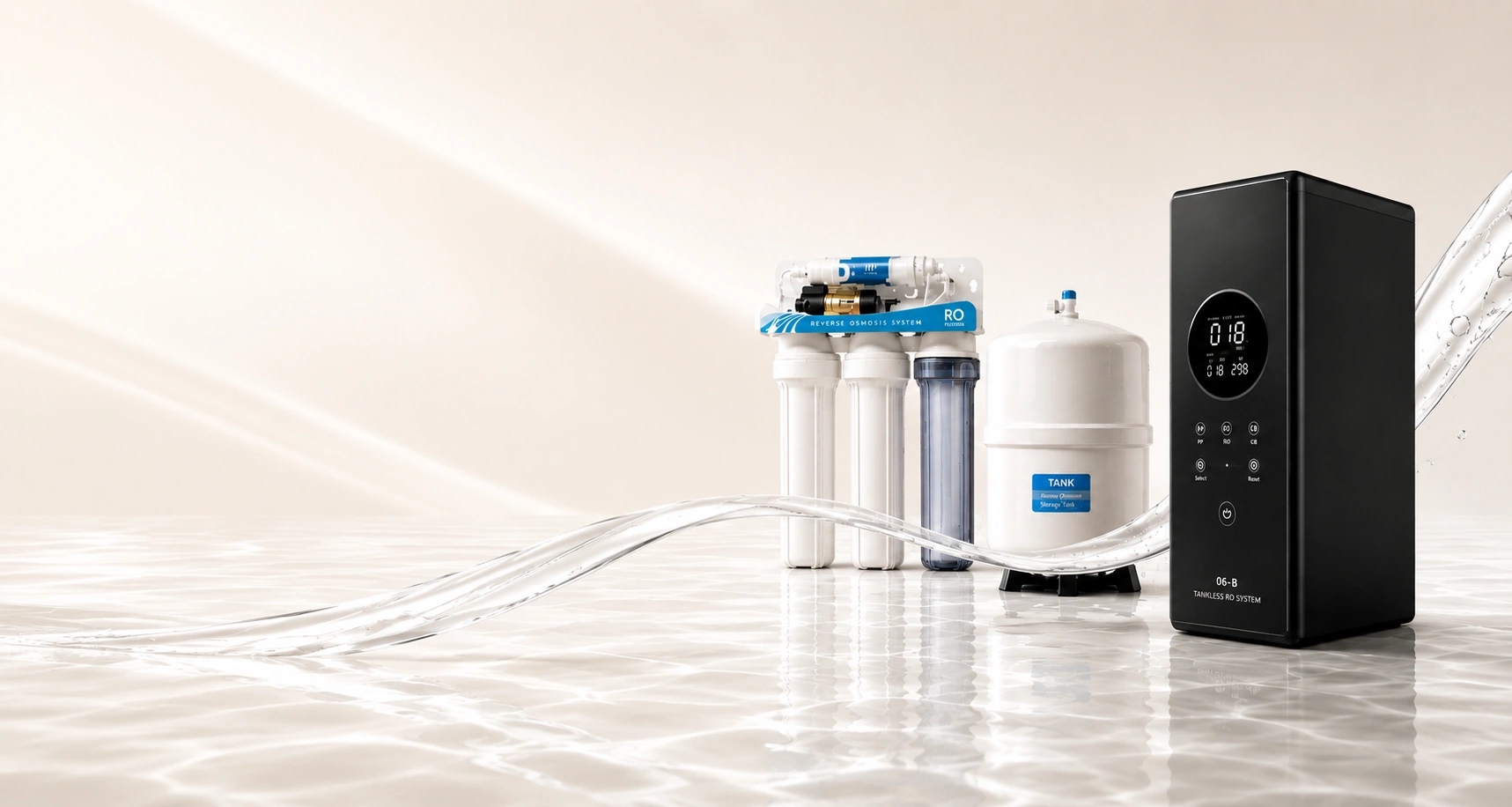
Reverse osmosis systems are widely used for residential drinking water purification, but not all RO systems are designed in the same way.
Two of the most common configurations are traditional RO systems with a storage tank and modern tankless RO systems with direct-flow water delivery.
For distributors, importers and private-label brands, choosing between the two is not simply a question of which technology is newer. Installation space, target price, local consumer preferences, flow requirements and product positioning can all influence which platform is more suitable.
This guide compares the two approaches from a product and market perspective.
What Is a Traditional Tank RO System?
A traditional under-sink RO system typically uses several filtration stages together with an RO membrane and a pressurized water storage tank.
Purified water is produced gradually and stored in the tank until the user opens the drinking water faucet.
Typical configurations may include:
- Sediment pre-filtration
- Activated carbon filtration
- RO membrane
- Post-carbon filtration
- Optional additional treatment stages
This design has been widely used for many years and remains a practical solution for markets where established RO formats and competitive pricing are important.
What Is a Tankless RO System?
A tankless RO system removes the conventional purified-water storage tank and instead produces filtered water through a direct-flow configuration.
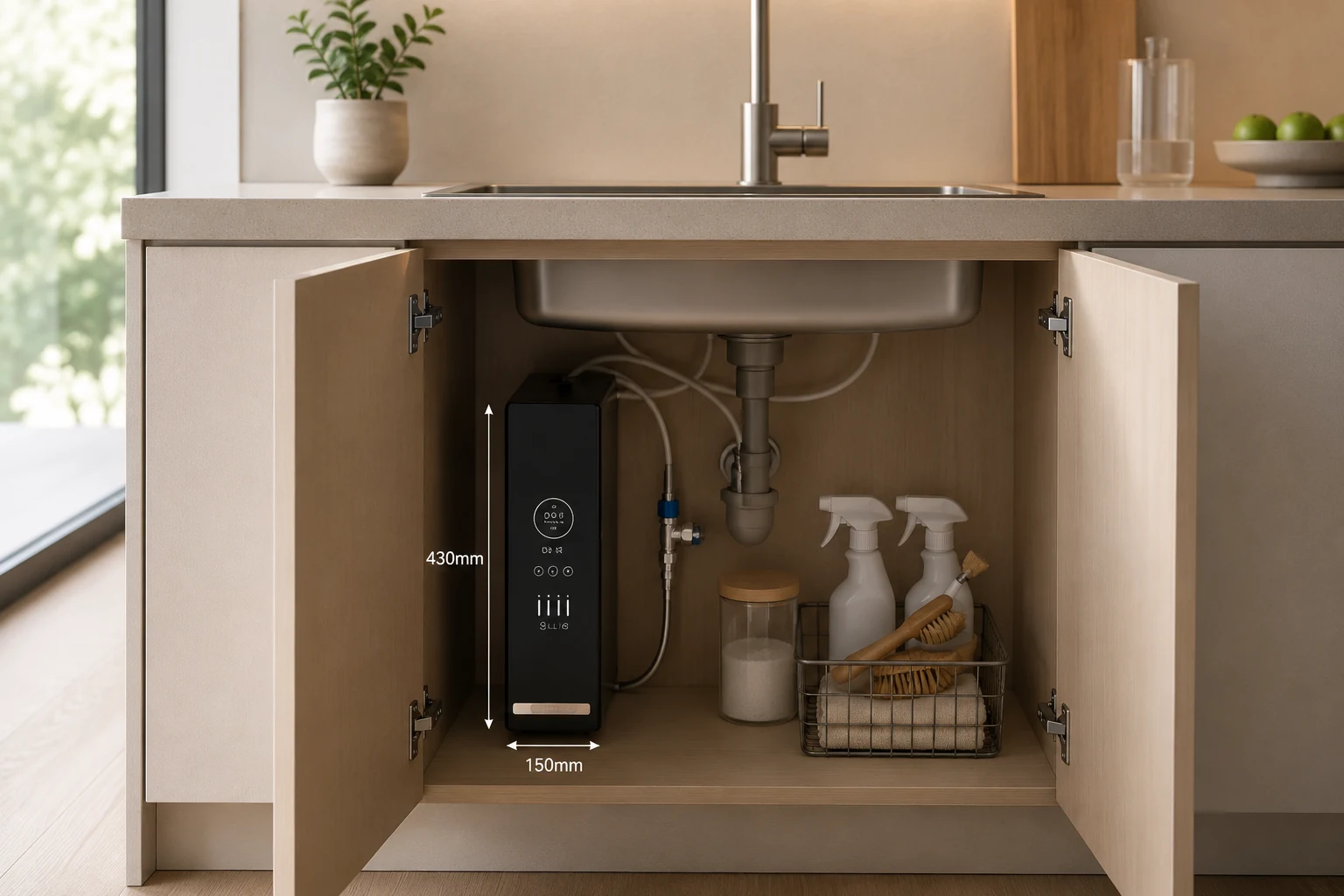
Modern tankless platforms often combine the filtration components inside an integrated cabinet, creating a cleaner and more compact under-sink installation.
Depending on the system configuration, tankless models may also support features such as:
- High-capacity direct-flow filtration
- Quick-change filter cartridges
- Integrated filter-life monitoring
- TDS monitoring
- Smart display interfaces
- Dual-water configurations
- Optional smart faucets
These features make tankless RO particularly suitable for modern residential and premium private-label product ranges.
Explore QLORA's tankless RO system platforms to review current designs and configurable project options.
Tankless RO vs Traditional RO: Key Differences
| Feature | Tankless RO System | Traditional Tank RO System |
|---|---|---|
| Water delivery | Direct flow | Stored purified water |
| Storage tank | Not required | Required |
| Under-sink footprint | Generally more compact | Requires space for system and tank |
| Product appearance | Integrated, modern cabinet | Traditional open-frame design |
| Flow positioning | Suitable for higher direct-flow configurations | Output supported by storage tank |
| Filter replacement | Often quick-change | Depends on housing design |
| Smart functions | Common on newer platforms | Usually simpler |
| Product positioning | Modern / premium | Established / value-oriented |
| OEM appearance customization | Strong potential | Mature standard platform |
Neither format is universally better. The right choice depends on the target market and intended product positioning.
1. Installation Space
Space is one of the clearest differences between the two formats.
Traditional RO systems require room for both the filtration assembly and a pressurized storage tank. This can occupy a significant portion of the cabinet beneath the kitchen sink.
Tankless systems eliminate the storage tank and usually integrate the filtration components into a compact enclosure.
For modern apartments and kitchens where under-sink storage is limited, this can be an important selling point.
2. Water Delivery and Flow
Traditional RO systems produce purified water and store it before use. When the faucet is opened, water is supplied from the pressurized tank.
Tankless systems instead rely on direct-flow purification.
For buyers evaluating tankless platforms, GPD capacity and actual water delivery requirements therefore become important product-selection factors.
QLORA's current tankless RO range includes multiple capacity configurations for different residential and OEM requirements.
3. Product Design and Consumer Positioning
Traditional RO systems are mature products and remain suitable for many price-sensitive or established water-treatment markets.
Tankless RO systems offer a different positioning opportunity.
The integrated cabinet can provide a cleaner appearance, while digital displays, TDS monitoring and smart faucet options can help create a more premium user experience.
For importers developing a modern appliance-style drinking water range, the exterior design of the system can therefore become almost as important as the filtration configuration itself.
4. Filter Replacement and Maintenance
Maintenance experience varies significantly between individual RO designs.
Traditional systems commonly use separate housings and cartridges. This provides flexibility but can require more steps during filter replacement.
Many newer tankless systems use integrated quick-change cartridges, allowing filters to be replaced with less disassembly.
For private-label projects, filter architecture should be considered early because it affects not only the user experience but also the long-term replacement-filter business.
5. TDS Monitoring and Smart Features
One advantage of newer tankless platforms is the ability to integrate additional monitoring functions.
Depending on the model, these may include:
TDS monitoring
Displays information related to incoming or purified water quality.
Filter-life indication
Helps users understand when cartridges may require replacement.
Smart display
Provides operating information directly on the system.
TDS faucet options
Allows selected water-quality information to be displayed at the faucet.
These functions are not required for every market, but they can help differentiate a premium product range.
6. Dual-Water Configurations
Another option available on selected tankless platforms is a dual-water configuration.
Instead of providing only RO purified water, the system can be configured to support two water outputs for different usage requirements.
A compatible dual-handle faucet can then allow the user to select the appropriate water output.
For OEM projects, filtration stages and water-output configuration should be determined according to the intended application and local water conditions.
7. Which System Is Better for Your Market?
A traditional tank RO system may be more suitable when:
- Competitive product cost is a major consideration
- Consumers are already familiar with conventional RO systems
- Installation space is less restrictive
- Simple and mature product architecture is preferred
A tankless RO system may be more suitable when:
- Compact installation is important
- The target market prefers modern kitchen appliances
- Higher direct-flow capacity is required
- Quick-change cartridges are desirable
- TDS monitoring or smart displays add value
- The product is positioned in a mid-to-premium segment
- Private-label differentiation is important
For some distributors, carrying both formats can also make sense because they serve different customer segments.
OEM and Private Label Considerations
For an OEM tankless RO project, the filtration system should not be selected based on appearance alone.
Before confirming a platform, buyers should consider:
- Target GPD capacity
- Local feed-water conditions
- Required filtration stages
- Cartridge configuration
- Desired water taste
- Single-water or dual-water output
- TDS monitoring requirements
- Faucet configuration
- Exterior design and color
- Branding
- Packaging requirements
The appropriate configuration can then be developed around the target market rather than treating every RO project as a standard product.
Explore QLORA RO Solutions
QLORA provides both traditional and tankless RO platforms for residential drinking water and OEM/private-label projects.
Our current tankless range includes compact systems with different capacity, filtration and monitoring configurations.
View all QLORA RO systems for a broader comparison.
RO system selection